All the Minutiae of Andre Barion
Amanda Tavares
One small difference beside another small difference. Perhaps that is why I take my time.
There is no detail at the edges of the structure. Detail builds structure.
A Curve Is Not Seduced by the Shortest Path
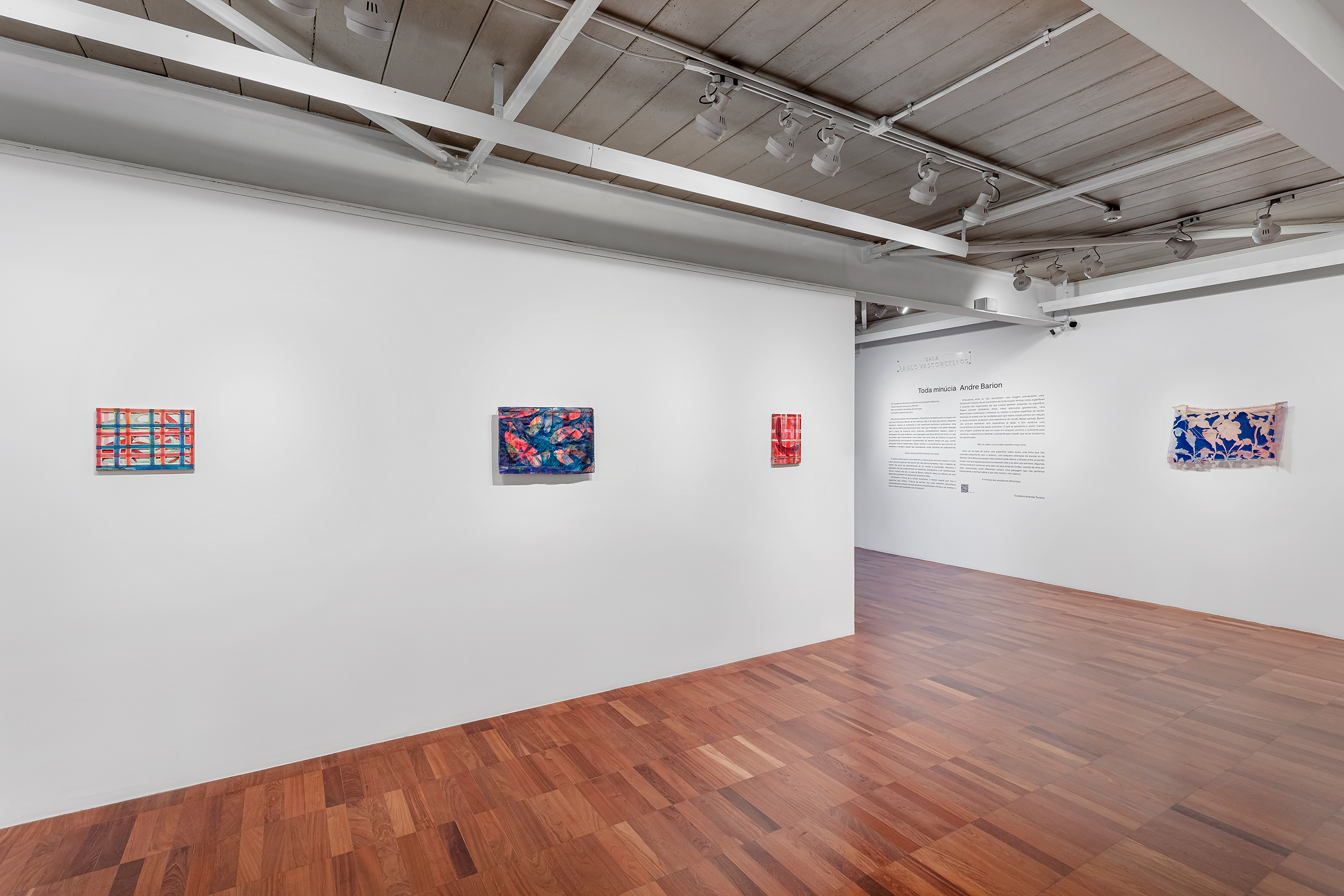
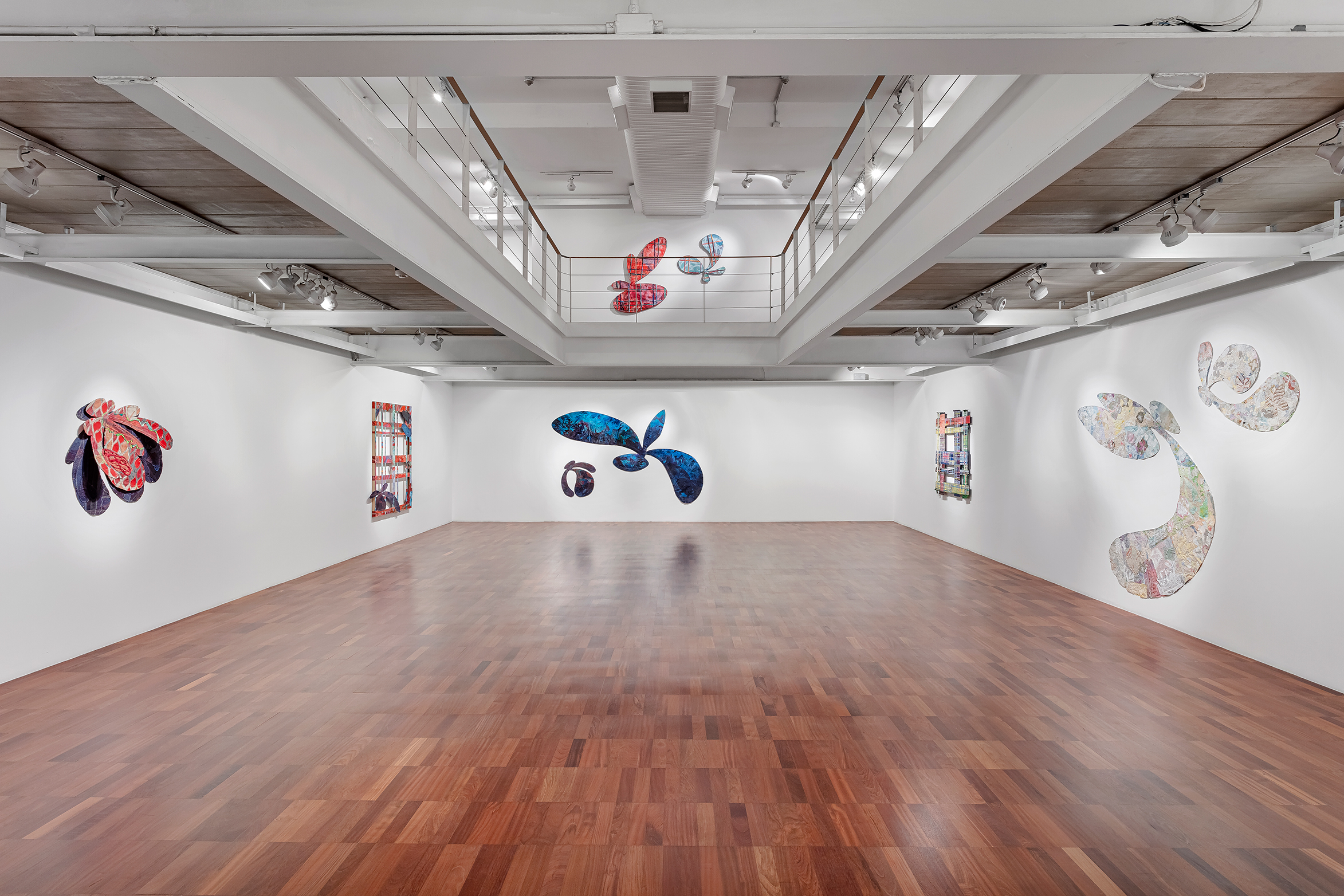
Over the past few years, Andre Barion’s research and production have pointed toward a progressive investigation of painting’s possibilities, drawing on materials and procedures traditionally situated outside its boundaries. Through this shift, fabric, thread, and pigment stop functioning as supports or auxiliary resources and begin to take part in building the language itself.
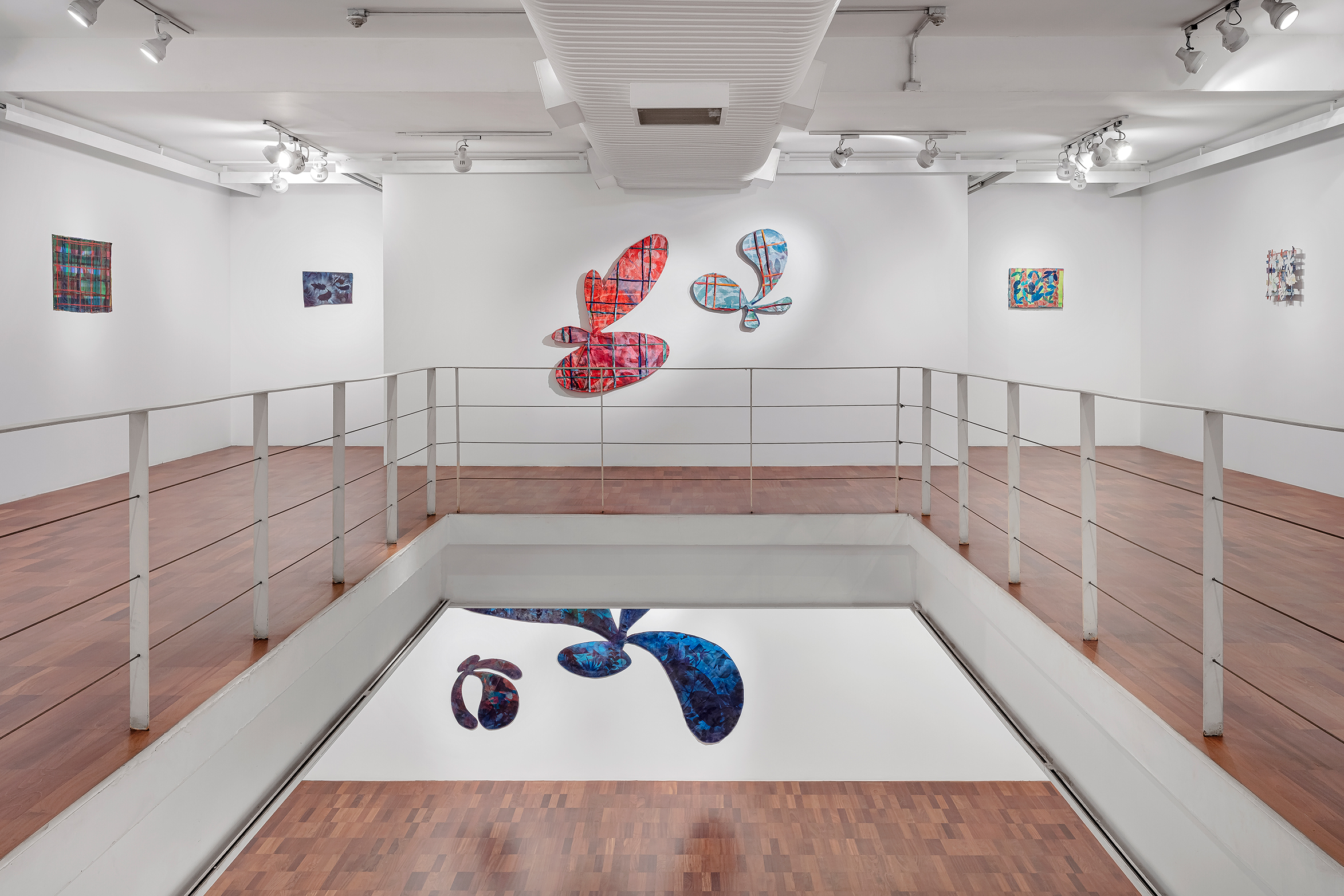
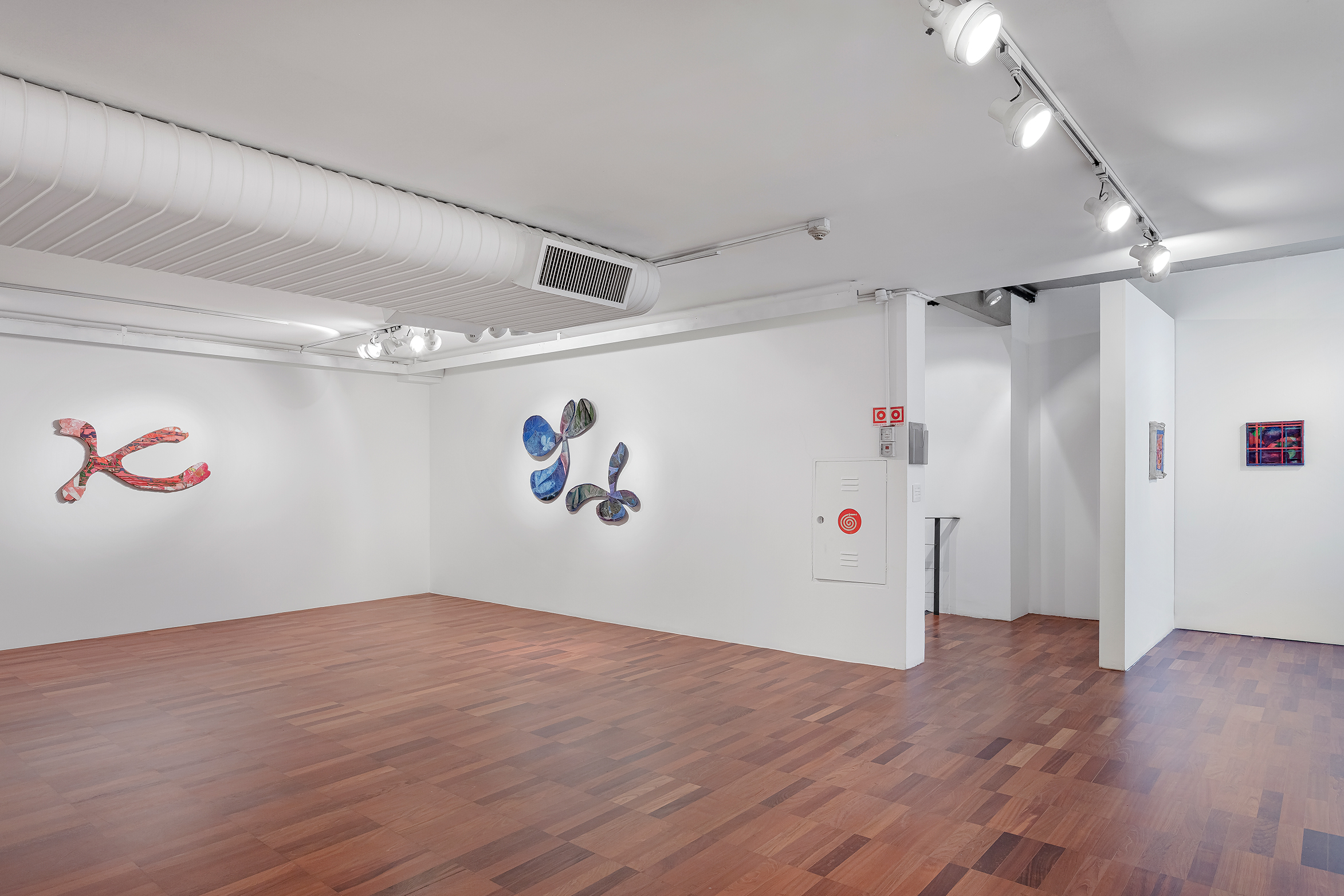
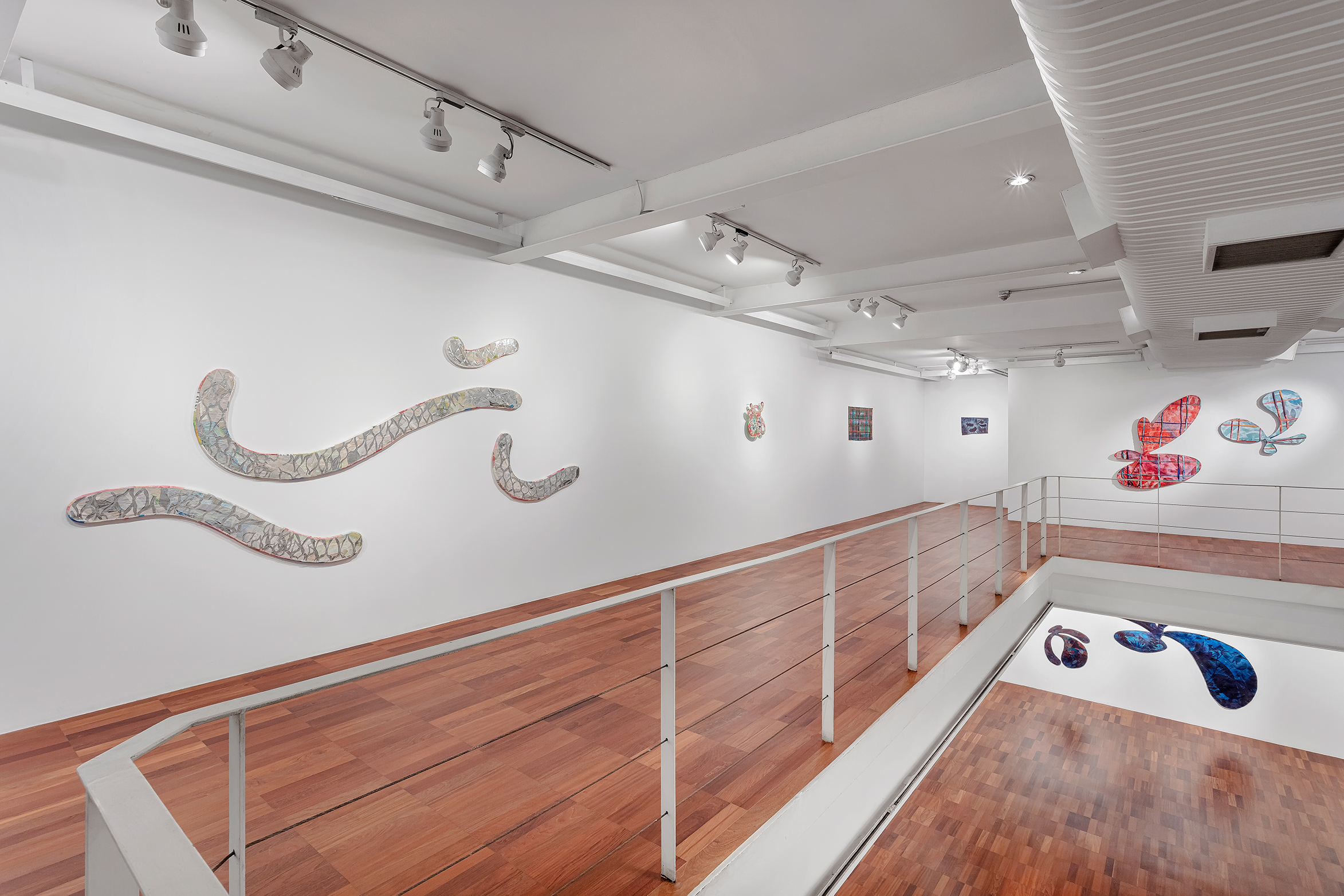
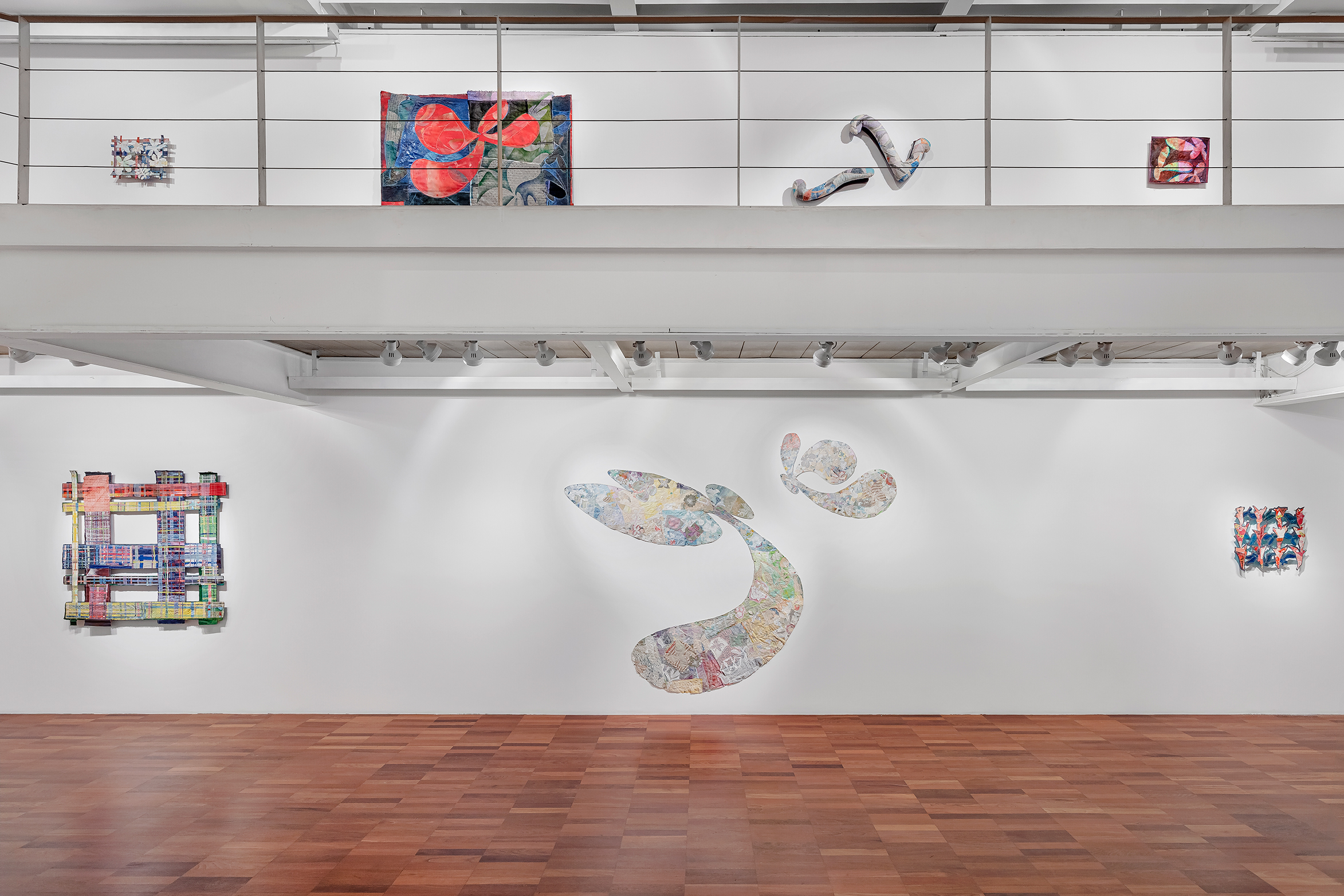
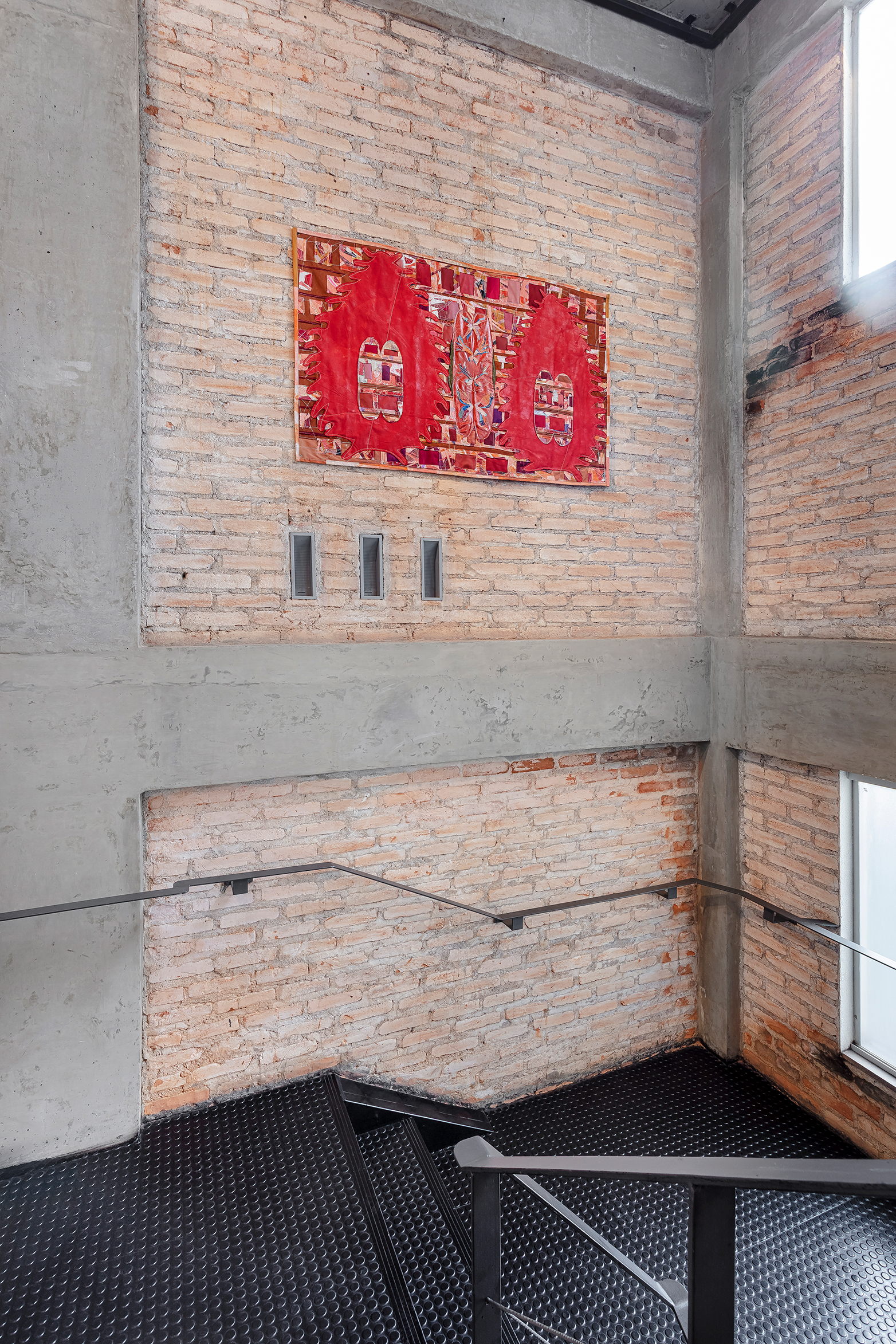
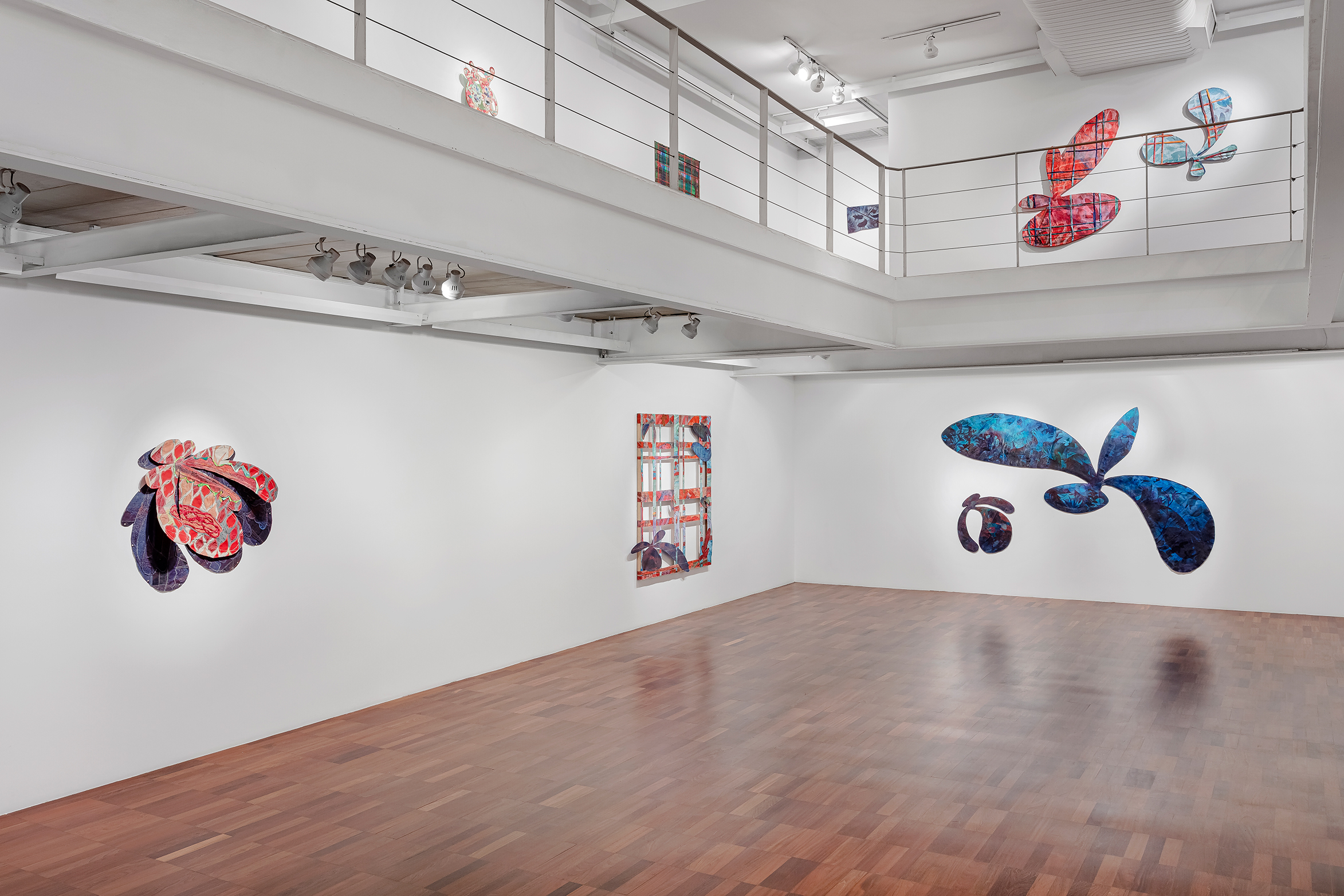
In these processes the surface is successively cut, layered, painted, and stitched, giving painting a thickness that brings it closer to sculptural space. Stitching draws, cuts produce forms, overlays build depth, and glazes turn color into an experience of light, transparency, and shadow. This is more than a combination of techniques. It is an expansion of the very field of painting, in which the image is no longer contained within a plane but takes shape in the relationship between surface, matter, volume, and space.
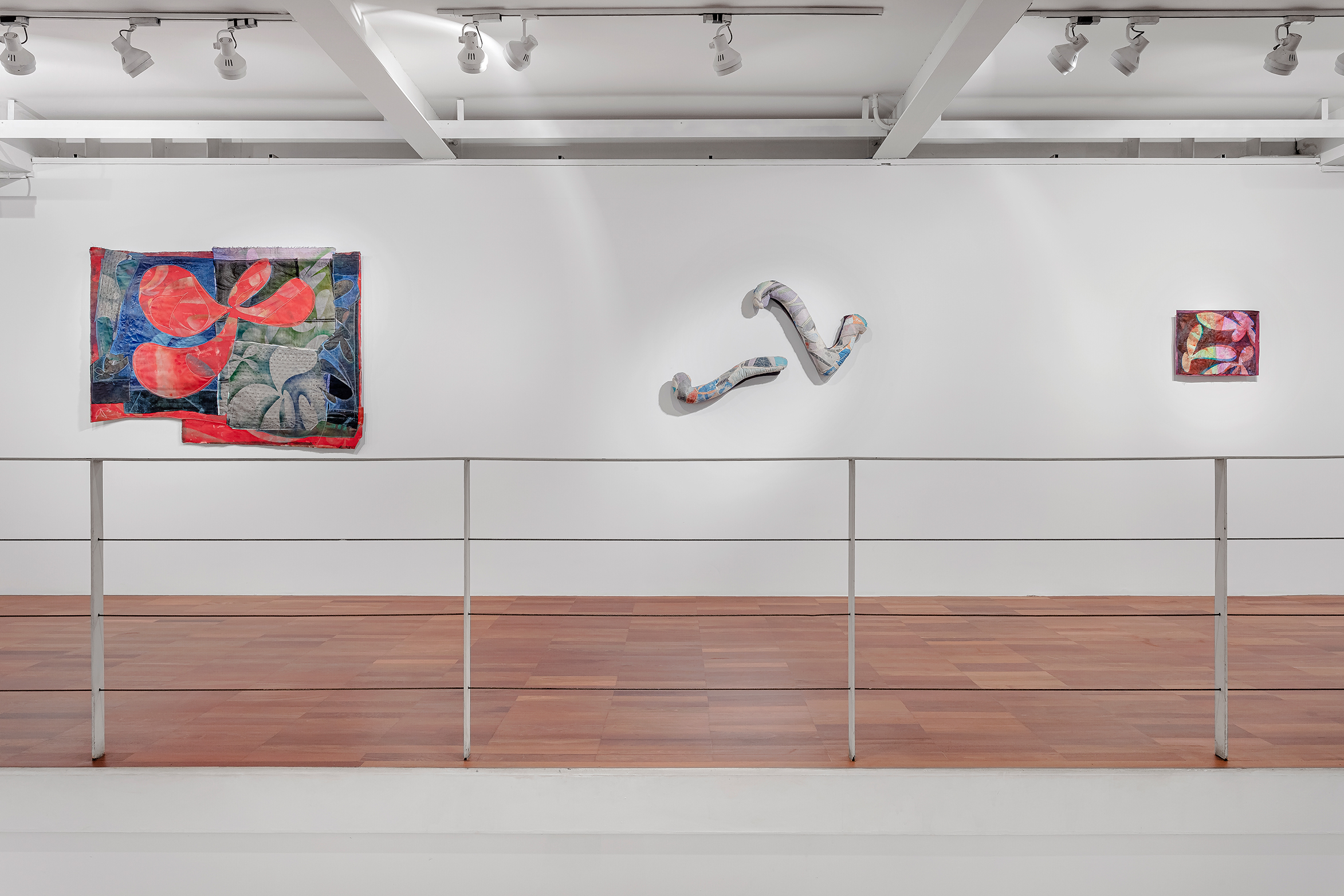
Along this path, the image is not offered as something already complete, but as an experience that is built before the viewer’s eyes. The layers of fabric, the pigment, the transparency, and the line produce varying degrees of visibility, so that some forms appear only to shift away again. Cutting, sewing, layering, painting, and letting things show through are operations that both produce form and modulate how it appears. This is why Barion’s works seem to remain perpetually in motion, even when fixed to the wall.
The works hold a deliberate instability, a refusal of conclusive form, which allows each element to be at once surface, drawing, body, or space. Minutiae, in this sense, has less to do with smallness than with the attention required to perceive the differences that make one thing become another.
Omar Porto’s research on the artist’s work, Tecido e pigmento no trabalho de Andre Barion: tatear uma prática aberta (Fabric and Pigment in the Work of Andre Barion: Feeling Out an Open Practice), carried out for this first exhibition of Barion’s work at Galeria Estação, points toward the same understanding. According to Porto, Barion does more than incorporate procedures associated with textile practices: he brings these materials into the heart of a pictorial inquiry, turning fabric into a field for drawing and formal construction. Porto traces a process in which forms first worked out in drawing pass into fabric, where cutting gives them body and an organic quality, while painting, layering, and stitching produce layers, thicknesses, and spatial relationships. He also draws attention to the role of glazes, transparency, light, and chromatic gradations, elements that make perception a constitutive part of the work. In his reading, the singularity of Barion’s research lies precisely in this tension between surface and volume, painting and space, the visible and the hidden.
Spools, Biases, and Detours
In discussing Andre Barion’s practice, Porto builds a network of affinities with artists and movements that, at different moments in art history, explored fabric, thread, stitching, cutting, and surface as elements of poetic construction. Among these references are Leda Catunda, whose closeness to Barion’s training the author highlights, as well as Arthur Bispo do Rosário, Leonilson, Brígida Baltar, Rosana Paulino, Sônia Gomes, and Ernesto Neto. Porto also draws on historical experiments developed at the Bauhaus and at Vkhutemas. At the Bauhaus he highlights the weaving of Gunta Stölzl and Anni Albers, and at Vkhutemas the investigations of Varvara Stepanova and Liubov Popova. Elsewhere, he relates Barion’s procedures to Henri Matisse’s papiers découpés, to the investigations of the French group Supports/Surfaces, and to works by Louise Bourgeois.
The author does not present these affinities as a direct genealogy of Barion’s work. Rather, they situate his practice within a broader history of testing the boundaries between painting, sculpture, drawing, textiles, and the applied arts. The network also reveals that these shifts take place in a context where the boundaries between art, craft, and textile practices have historically been entangled with questions of gender, race, hierarchy, and institutionalization.
What matters in these encounters, then, is not recovering a technique in its original form or spotting a visual resemblance. It is perceiving how certain problems resurface under new conditions and recognizing shared concerns.
In the Brazilian context, Porto’s comparisons show how fabric, thread, and stitching run through different generations and practices without forming a single language. In Bispo do Rosário, the gathering and transformation of everyday objects produce a singular ordering of the world. In Leonilson, thread, fabric, and stitching become vehicles of intimacy, fragility, and subjective inscription. In Rosana Paulino, the suture links materiality and historical memory, turning the act of joining and mending into an operation charged with meaning. These artists need not be taken as direct antecedents to Barion. Rather, they form a field of possibilities in which different artists demonstrate that materials historically associated with domestic labor, craft, or the so-called applied arts can become instruments of conceptual and formal elaboration.
From this perspective, the constellation Porto presents can unfold in other directions. Olga de Amaral’s work, for example, deepens the relationship between fabric, surface, and space. By exploring fiber, color, weave, and structure in constructions that often take on architectural and sculptural dimensions, de Amaral dissolves the separation between painting, sculpture, and textile. Her work matters here not because it establishes a lineage with Barion, but because it makes visible a possibility that also runs through his practice: understanding fabric not as the support for a previously formed image, but as matter that intervenes in the very construction of the work. Once the surface gains thickness, shadow, transparency, and spatial presence, painting can no longer be thought of solely in terms of its flatness.
This passage from plane to space takes other forms in the work of Sheila Hicks and Magdalena Abakanowicz. Hicks expands the possibilities of fiber through color, structure, scale, and volume, while Abakanowicz radicalizes the transformation of textile into sculptural presence. Both belong to the group of artists who, especially from the 1960s and 1970s onward, helped broaden the spatial and three-dimensional possibilities of textile media. What is particularly compelling in Hicks is the way color is inseparably bound to the physical structure of the fiber. Barion’s procedure is different, but in his work too, color is not merely a visual property applied to a conventional surface. It is absorbed by the fabric, passes through its layers, and settles over them, producing varying degrees of opacity, transparency, and luminosity. Color thus takes part in the material makeup of the surface.
This instability between surface and matter is precisely where Abakanowicz’s work gains a further dimension for reading Barion. Porto mentions her in his survey of the history of tapestry. She helped move fiber away from its traditionally two-dimensional condition, giving fabric a bodily, sculptural, and architectural presence. So-called Fiber Art, especially from the 1960s onward, consolidated some of these experiments by broadening what textile materials could do.
The point is not to classify Barion as a sculptor or a textile artist. It is to recognize that his practice belongs to a moment in art when the opposition between plane and volume no longer presents itself as a necessary division. His layered fabrics, stitching, thicknesses, and coats of paint produce a surface that remains pictorial while projecting into space.
If the work of de Amaral, Hicks, and Abakanowicz traces the passage from textile to space, Sonia Delaunay’s career leads to an earlier question: what happens when fabric itself takes part in pictorial thinking? Her output spanned painting, textiles, fashion, and design, allowing color and form to circulate across different supports and fields of production. This circulation blurs the line between what belongs to painting and what would traditionally be assigned to the applied arts. Instead of treating fabric as a material that later receives a pictorial language, her work shows it to be one of the places where that language can be built. This is where her experience meets a question present in Barion: fabric does not come after painting, as a mere substitute for canvas, but takes part in working through properly pictorial problems.
This relationship between painting and fabric leads, in turn, to the question of ornament. In Barion, the organic forms, arabesques, and volutes that Porto links to the Baroque and Rococo are not simply decorative elements laid over an established pictorial structure. They are part of the very organization of the surface, creating rhythms, overlaps, and directions for the eye. The opposition between the decorative and the constructive can also be challenged through the work of Miriam Schapiro. She incorporated materials and procedures associated with domestic space and women’s labor, questioning the hierarchies that have historically separated art from craft, and high culture from low. In her work, what might be identified as ornament no longer plays a secondary role and becomes part of the work’s construction. Something similar happens with shadows.
Whoever cuts a line finds a body in shadow
In Andre Barion’s work, shadow seems to be more than what a form casts. It can be constructed, cut out, layered, and incorporated into the very matter of the work. In Regina, the relationship between shadow and surface is especially clear: the shadow is not just an effect of light falling on a form, but part of how the image is built. In this sense, the work evokes a tradition in which shadow is no longer merely the consequence of a body’s presence and also becomes a pictorial problem. The reference to Regina Silveira matters precisely because she moved shadow out of its secondary place. In her work, shadow can gain autonomy, occupy the surface, and produce a presence that does not necessarily match the object that supposedly cast it.
In works such as Contraluz, Komorebi II, and Pegando borboletas, this question unfolds through the choice of materials. Voile, cotton, twill, and denim differ in opacity, transparency, thickness, and absorbency. When these materials are painted, layered, and stitched, light does not fall on a uniform surface. It passes through some parts and meets others, and the structure of the work interrupts, filters, or reflects it back. Shadow thus arises from the relationship between materials. The aim is not only to represent a shadow, but to create the material conditions for one to occur.
In A visão da crisálida, this relationship appears in yet another way. The shadow is not necessarily tied to an external body casting it onto the painting. It helps form the very body of the work. Iron, fabric, and paint establish relationships of weight, transparency, thickness, and luminosity that make perception waver between what seems to lie on the surface and what stands in front of it. Shadow is no longer a secondary element of the image. It becomes a kind of intermediate matter between the visible and what remains partly hidden.
This also makes it possible to see the butterflies that recur in Barion’s recent work as more than a motif. In Pegando borboletas, A visão da crisálida, Gaiola de borboletas, and Catando borboletas, pescando flores, the butterfly moves through different combinations of fabrics and painting techniques. Rather than being a stable image that simply repeats, it seems to offer the artist a structure that can be taken apart and rebuilt. The wings, the outlines, the areas of color, and the gaps between the parts become opportunities to test what each material can do with the same form.
At this point, Barion’s painting also becomes an investigation into how materials themselves produce images. Oil, acrylic, enamel, watercolor, pastel, and pigments do not behave the same way on twill, cotton, voile, or denim. Each combination changes how color settles, seeps through, covers, or lets what lies beneath show through. In NAFNSB-SRPV-V4H4-10510, for instance, combining oil, acrylic, watercolor, pastel, and enamel with different fabrics produces a surface where the paint cannot be fully separated from what it is applied to. The material is no longer a passive support. It affects color, texture, and transparency, and therefore the very configuration of the image.
Butterflies hold a special place in this process because they carry a recognizable form that is still open enough to transformation. As the figure passes through different materials and procedures, it may lose the stability of its outlines, grow more opaque or more transparent, gain weight or seem to float. What changes, then, is not only how the butterfly looks, but the relationship between figure and surface. Painting finds in the motif a way to test its own limits. How far can a form be altered and still be recognized? And at what point does what we recognize as a figure become, above all, matter, color, line, and structure?
This question leads directly to the spatial dimension of the work. Barion’s three-dimensionality is not a simple passage from painting to sculpture. It is the result of a painting that is no longer content with being flat.
Layers of fabric can create thickness. Cutouts can produce projections and recesses. Stitching can pull a surface taut. Materials such as wood and iron introduce weight and structure. In Komorebi II, for example, the iron combined with layers of fabric gives the surface real thickness. The work does more than occupy a wall: it establishes a specific physical relationship with space.
Three-dimensionality, then, should not be understood as something added to painting, but as something that emerges from painting’s own operations. Cutting, folding, layering, stitching, and painting change the image and the body of the work at the same time. The surface is no longer just the place where something happens. It becomes a structure that actively shapes what we see. Shadow, transparency, volume, and color come to depend on one another.
Perhaps this is precisely where Barion’s research finds one of its most persistent questions: the image cannot be fully separated from the matter it is made of. It may appear as shadow, figure, color, or drawing, but each of these appearances depends on a specific surface, a thickness, an overlap, a distance. What we see is not merely an image built from different materials. It is an image that transforms because those materials are different. Along this path, painting does not abandon the plane to reach space. It turns the plane itself into a place of passage.