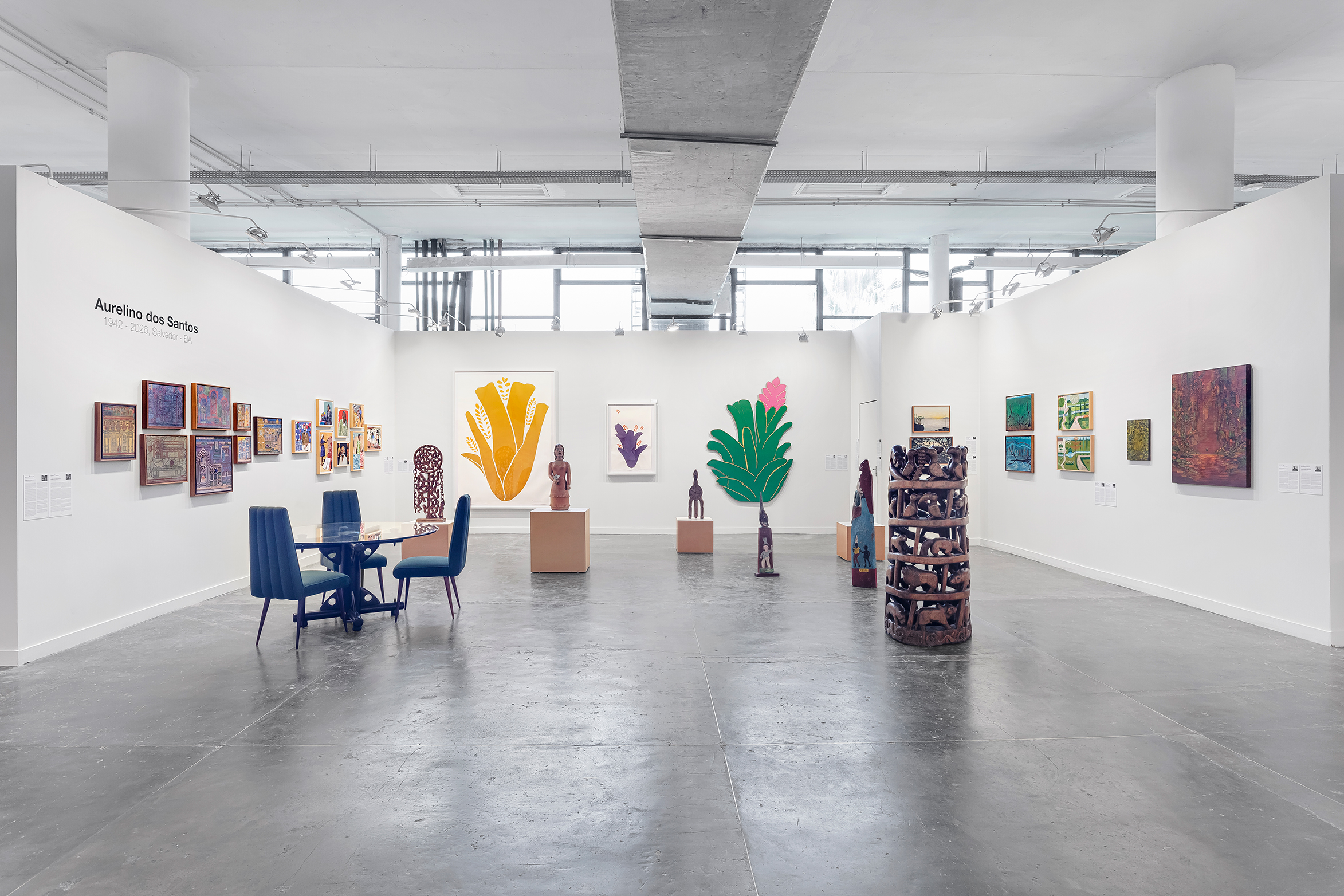
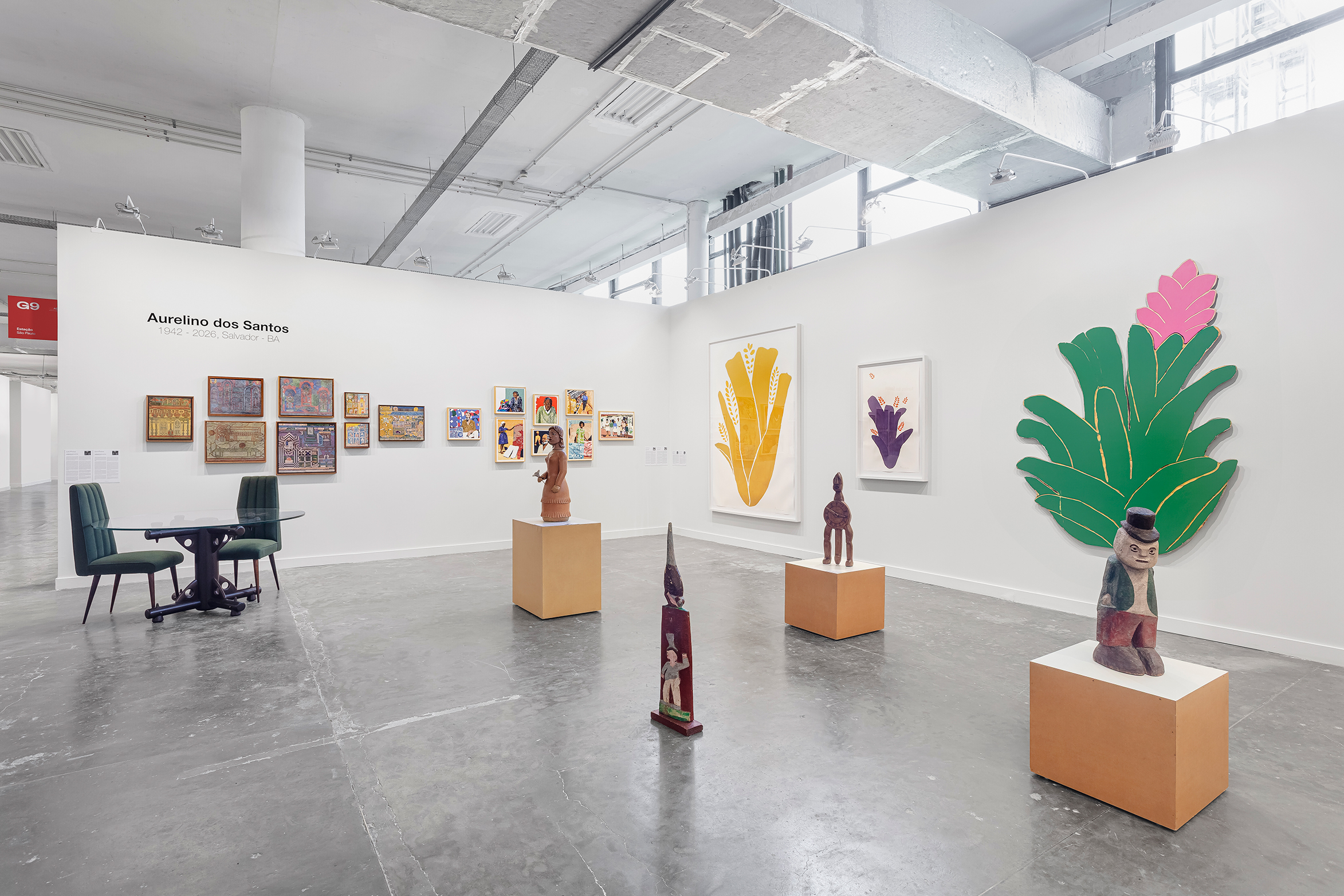
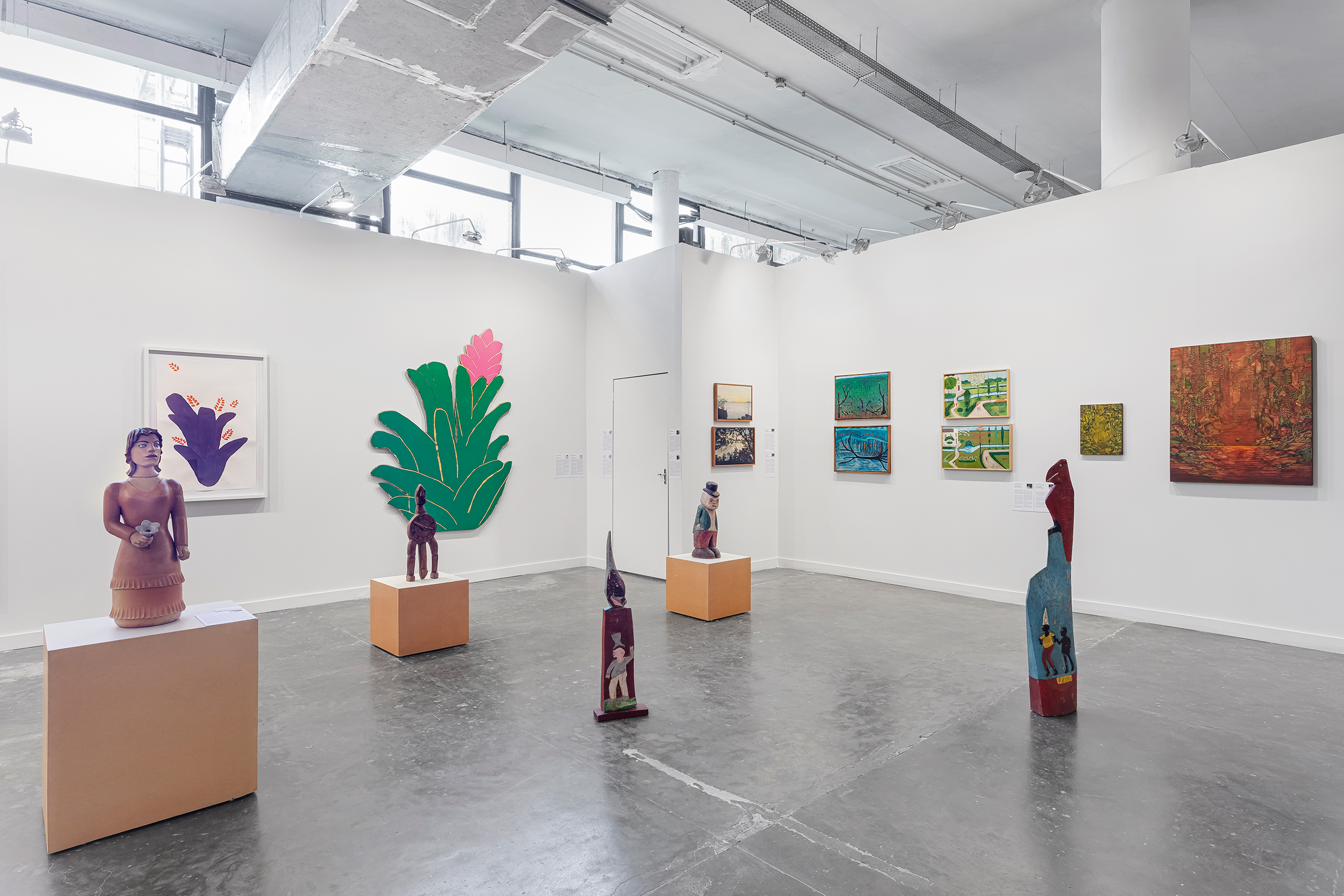
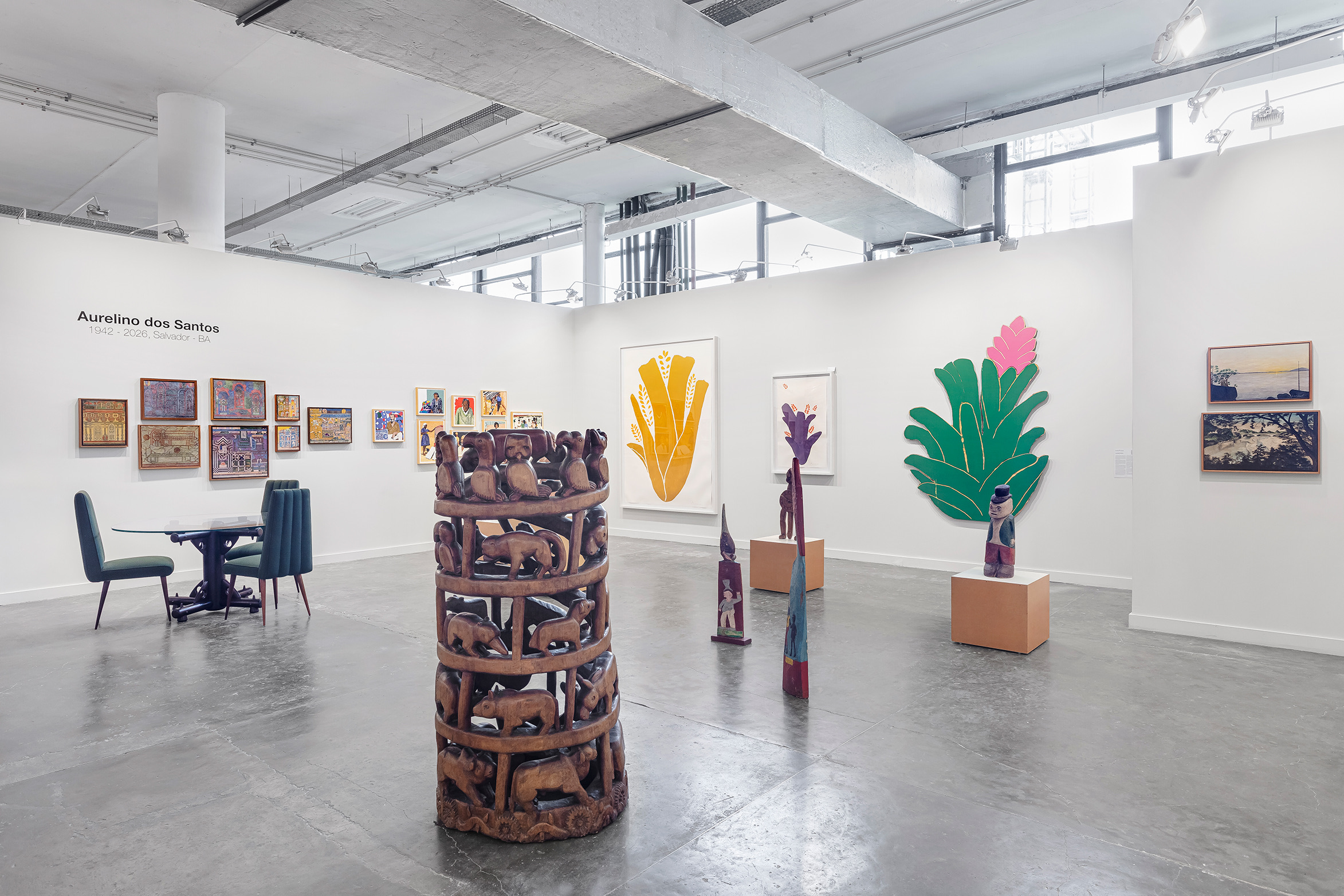
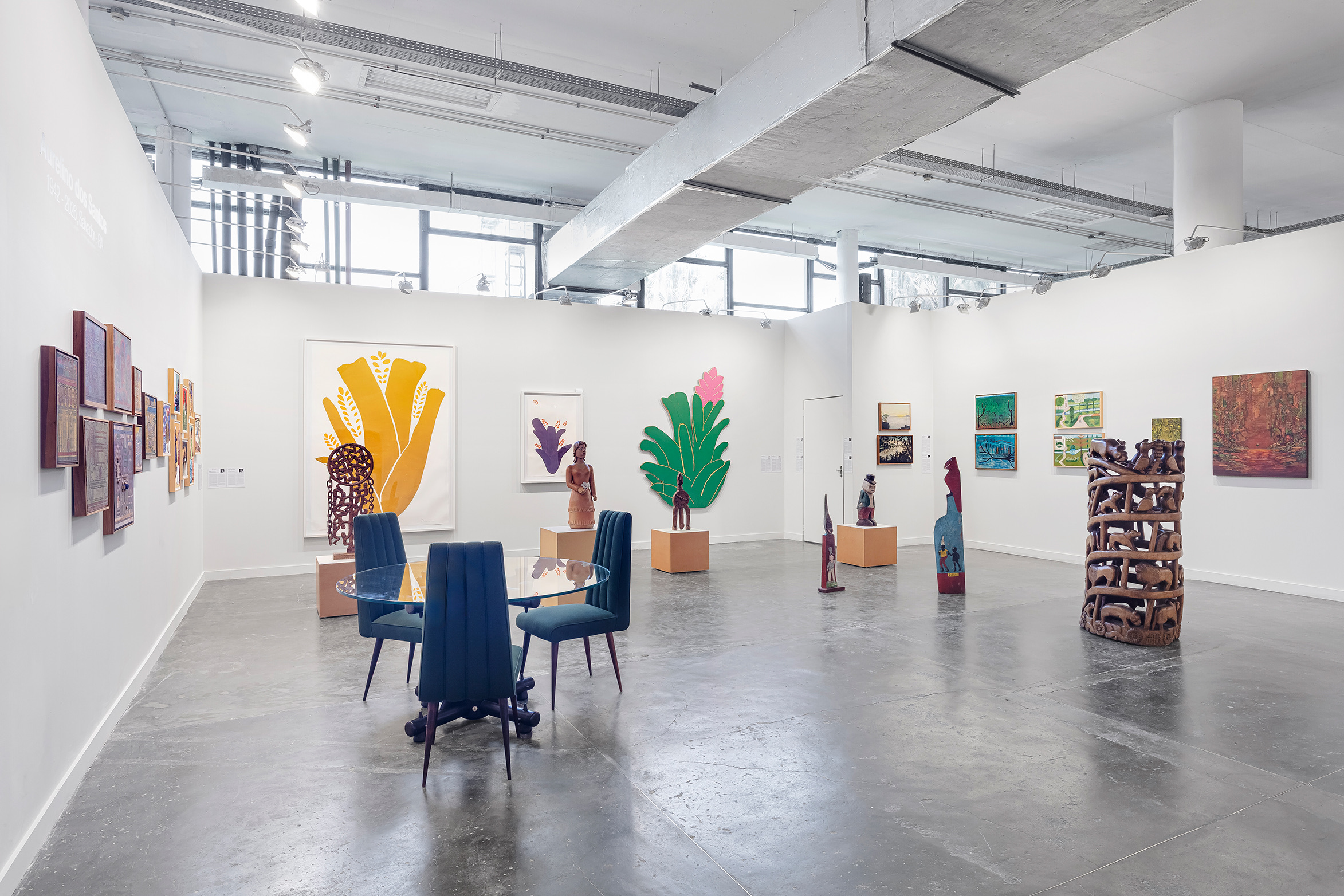
For SP-Arte 2026, Galeria Estação presents a booth conceived as a territory of encounters — a space where different temporalities of Brazilian art intersect and recognize one another. We bring together eleven artists whose trajectories, while diverse in origin, generation, and language, share a profound relationship with memory, imagination, and the reinvention of form.
The project’s conceptual framework is grounded in the idea of an expanded landscape — understood not merely as a representation of natural or urban space, but as a symbolic construction of worlds. Curated by Galeria Estação, the presentation proposes a dialogue between historical masters of Brazilian popular art and contemporary artists who challenge and reconfigure this legacy.
On one hand, the sculptural strength of Artur Pereira (1920–2003) is represented by a vertically composed wooden work in which animals organize themselves in circular and ascending movements. Carved in cedar, the piece reveals his technical mastery in articulating architectural structure and organic form, creating a dynamic visual narrative where fauna and constructive rhythm intertwine. The work synthesizes his ability to transform wood into both an imaginative and structural field.
The geometric architectures and chromatically vibrant compositions of Aurelino dos Santos (1942–2026) — who passed away in January of this year — reaffirm his singular place in Brazilian painting. He began his practice in the 1960s, developing an artistic trajectory shaped by the influence of Bahian sculptor Agnaldo Manoel dos Santos (1926–1962) and the encouragement of Lina Bo Bardi (1914–1992), then director of MAM Bahia. He was in close contact with key figures of the period, including Mário Cravo Neto, whom he assisted in his studio. His structured landscapes organize idealized readings of the city of Salvador, articulating simultaneous perspectives and compositional rigor. His work is held in major institutional collections such as Instituto Inhotim (Brumadinho, MG) and Museu Afro Brasil Emanoel Araújo (São Paulo, SP), among others.
The pictorial narratives of Cardosinho (1861–1947) and Júlio Martins da Silva (1893–1978) present two distinct approaches to constructing visual memory. Cardosinho, whose works are held in MoMA in New York and Tate Modern in London, developed compositions that combine erudition, imagination, and formal freedom. Júlio Martins da Silva, represented in collections such as the Pinacoteca do Estado de São Paulo and Museu Afro Brasil Emanoel Araújo, created true visual chronicles of urban life with historical sensitivity.
The symbolic density of Chico Tabibuia’s sculptures (1936–2007) will be represented by a work of significant formal and conceptual strength — as evidenced by his inclusion in the exhibition Histórias da Ecologia (September 5, 2025 – February 1, 2026) at the Museu de Arte de São Paulo (MASP), reaffirming the critical and institutional relevance of his production.
From Izabel Mendes da Cunha (1924–2014), we present a clay sculpture of a standing female figure, marked by serene presence and concentrated expression. The artist imbues her figures with a quiet dignity and a balanced volumetric construction, where the body unfolds in simple and continuous planes. Delicacy contrasts with structural solidity, revealing the expressive strength she developed in the Vale do Jequitinhonha. Her work is part of the collection of the Fondation Cartier pour l’Art Contemporain in Paris and is currently included in the exhibition Exposition Générale, on view through August 2026.
The essential power of the carved forms by Nino — João Cosmo Feliz (1920–2002) — reaffirms the artist’s inventive autonomy. Working with minimal tools, he combined three-dimensional figures, low-relief elements, and painting, primarily using imburana and aroeira wood. His universe is populated by human figures, animals, and scenes of everyday life in Northeastern Brazil, arranged in compositions that invite the viewer to move around the work, generating open narratives and multiple readings. Recognized as a master during his lifetime, he participated in major exhibitions such as O essencial em estado bruto (Pinacoteca do Estado de São Paulo, 2001) and is included in important collections, including the Fondation Cartier (Paris).
In dialogue with this body of work, we initially present three contemporary artists whose practices expand this notion of landscape and imagination:
Rafael Pereira (1986) is currently on view at Galeria Estação with the exhibition Rafael Pereira: A cabeça de Zumbi, featuring a critical text by Renato Menezes. At the fair, he presents a series of oil pastel drawings on paper dedicated to portraying key historical figures in Brazilian art, including Mestre Guarany, Agnaldo Manoel dos Santos, Mestre Didi, Izabel Mendes da Cunha, Maria Auxiliadora Silva, Júlio Martins da Silva, Chico Tabibuia, Artur Pereira, Madalena Santos Reinbolt, and Aurelino dos Santos. Based on photographic images from publications such as Teimosia da Imaginação – Dez Artistas Brasileiros and A mão afro-brasileira, these works transform documentary imagery into compositions of strong chromatic presence. In 2025, the artist participated in the Sertão Negro residency, further deepening his research into memory and Brazilian art history.
Santídio Pereira (1996) is presented through unique woodcut works, as well as gouache on paper and wooden objects. Marked by synthetic botanical forms, precise cutouts, and intense color, the selected works highlight his investigation into biomes and the reinvention of woodcut as object-work. In late 2025, he participated in a residency in Angola with FAS – Forward Art Stories, and in May of this year he will take part in a residency in the Atacama Desert, Chile, through Awasi’s Art Immersion, expanding the international reach of his practice.
Alexandre Wagner (1986), in turn, presents paintings that tension the relationship between representation and abstraction. Through a liquefied pictorial language, landscapes, suns, and elements of the world dissolve into points of color and rapid brushstrokes.
In a second moment, we will present works by two additional contemporary artists.
Higo José (1994) develops a practice that combines embroidery, sculpture, and installation, drawing on references to ancestral material cultures. Inspired by archaeology and visual traces of distant times, his work reconfigures figures and scenes across textile surfaces and sculptural forms that evoke megalithic structures. His practice establishes a dialogue between past and present, where ancestry and contemporary language converge.
Andre Barion (1996) develops a textile-based poetics that articulates sewing, painting, and nature.
The booth will be organized as a sensorial journey, in which wood, clay, paint, paper, and matrix engage through formal proximities — the verticality of sculpture, the chromatic construction of paintings and drawings, and the recurring presence of nature and the human figure. Rather than segmenting by period or category, we propose a direct coexistence between works that, though distant in time, share structural concerns: the relationship to manual making, the autonomy of gesture, and the construction of self-contained worlds.
Among the highlights, we present sculptures of strong institutional relevance, paintings and works held in major international and national museum collections, as well as contemporary works that reaffirm the vitality of Brazilian artistic production.
At SP-Arte 2026, our space is conceived as an invitation to listen and contemplate — a place where tradition and contemporaneity recognize themselves as part of a shared, ever-evolving history.